Annual Reports
KBR, Inc.'s annual reports contain management's most considered account of the business. These are the sections, passages and visual pages worth opening in the originals preserved in Sources.
KBR, Inc. — Fiscal 2025 Annual Report (Form 10-K) — Fiscal 2025 (year ended Jan 2, 2026)
The year KBR recast itself: it renamed Government Solutions to Mission Technology Solutions and moved to spin it off into a separate public company. · Open the full document →
Item 1. Business — Company Overview — p. 12 · Read the full section →
How management defines KBR and its shift toward technology-driven, higher-return solutions for governments and commercial clients.
What KBR is and the operating-model shift management is steering in fiscal 2025.
KBR, Inc., a Delaware corporation ("KBR" or, the "Company"), delivers science, technology, engineering and logistics support solutions to the U.S. federal government, allied nations and commercial clients around the world. […] In the fiscal year ended January 2, 2026 ("fiscal 2025"), KBR’s operating model continued to shift toward agile, technology-driven, solutions-oriented delivery and was streamlined to increase strategic focus and to move upmarket into differentiated areas that we believe will provide attractive returns and consistent growth with favorable cash conversion.
p. 12 · Read in context →
Item 1. Business — Our Business Segments — p. 16 · Read the full section →
The two engines of revenue: defense/space mission services (MTS) and 85+ proprietary sustainability process technologies (STS).
The two core segments — Mission Technology Solutions and Sustainable Technology Solutions — in management's words.
Mission Technology Solutions. Our Mission Technology Solutions business segment provides full life-cycle support solutions to defense, intelligence, space, aviation and other programs and missions for military and other government agencies primarily in the U.S., U.K. and Australia. […] Sustainable Technology Solutions. Our Sustainable Technology Solutions business segment is anchored by our portfolio of over 85 innovative, proprietary, sustainability-focused process technologies that reduce emissions, increase efficiency and/or accelerate and enable energy transition across the industrial base in four primary verticals: ammonia/syngas, chemical/petrochemicals, clean refining and circular process/circular economy solutions.
p. 16 · Read in context →
Item 1. Business — Mission Technology Solutions Spin-off — p. 18 · Read the full section →
The defining strategic event: KBR intends to split its largest segment into a standalone public company, targeted for 2H fiscal 2026.
The planned tax-free spin-off of Mission Technology Solutions.
In September 2025, we announced our intention to spin off our Mission Technology Solutions business into a separate, U.S. publicly-traded company (the "Planned Spin-Off"). The Planned Spin-Off is intended to be tax-free to us and our shareholders for U.S. federal income tax purposes and targeting completion in the second half of the fiscal year ended January 1, 2027 ("fiscal 2026"). The spin-off will be subject to final approval by our Board of Directors and other customary conditions, including receipt of a favorable opinion of legal counsel and/or a private letter ruling from the U.S. Internal Revenue Service with respect to the tax treatment of the transaction for U.S. federal income tax purposes, the effectiveness of a registration statement on Form 10 filed with the SEC, satisfactory completion of financing and other regulatory approvals. Because the intended transaction is a spin-off, the Mission Technology Solutions business is not classified as held for sale and will be reported as continuing operations.
p. 18 · Read in context →
Item 1A. Risk Factors — p. 47 · Read the full section →
The two risks most specific to KBR: executing the spin-off, and dependence on government budgets — U.S. agencies alone are ~57% of revenue.
Revenue concentration in government spending that customers can modify or terminate at will.
Demand for our services provided under government contracts is directly affected by spending by our customers. […] We derive a significant portion of our revenues from contracts with agencies and departments of the U.S., the U.K. and Australia governments, which is directly affected by changes in government spending priorities and availability of adequate funding. […] The loss of work we perform for governments or decreases in governmental spending and outsourcing could have a material adverse effect on our business, results of operations and cash flows.
p. 55 · Read in context →
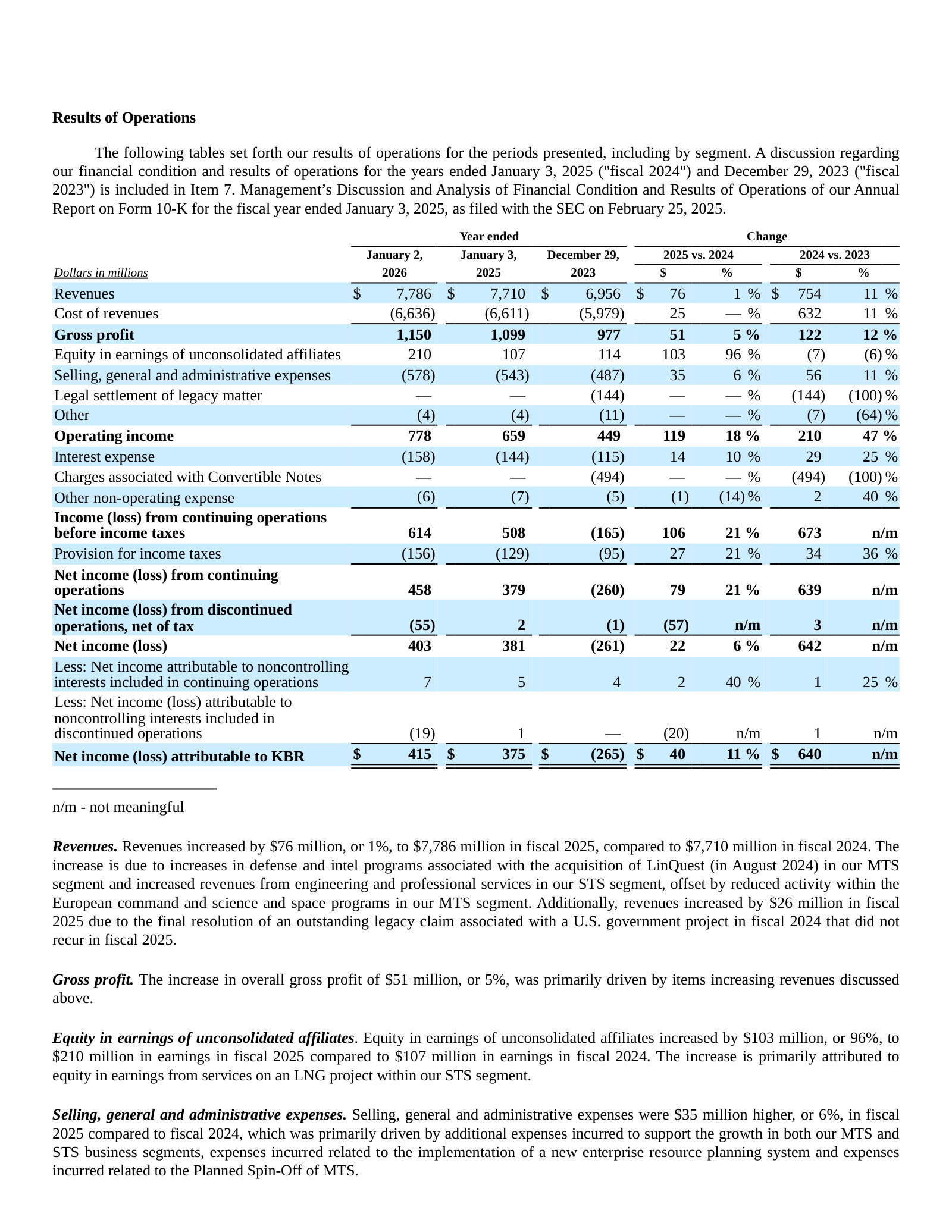
Item 7. MD&A — Results of Operations — p. 82 · Read the full section →
Revenue up 1% to $7,786M yet operating income up 18% to $778M — the margin and equity-earnings story management tells for fiscal 2025.
Item 7. MD&A — Results of Operations by Business Segment — p. 85 · Read the full section →
Segment economics: MTS $5,581M revenue / $463M operating income, STS $2,205M / $477M — STS the smaller, higher-margin engine.
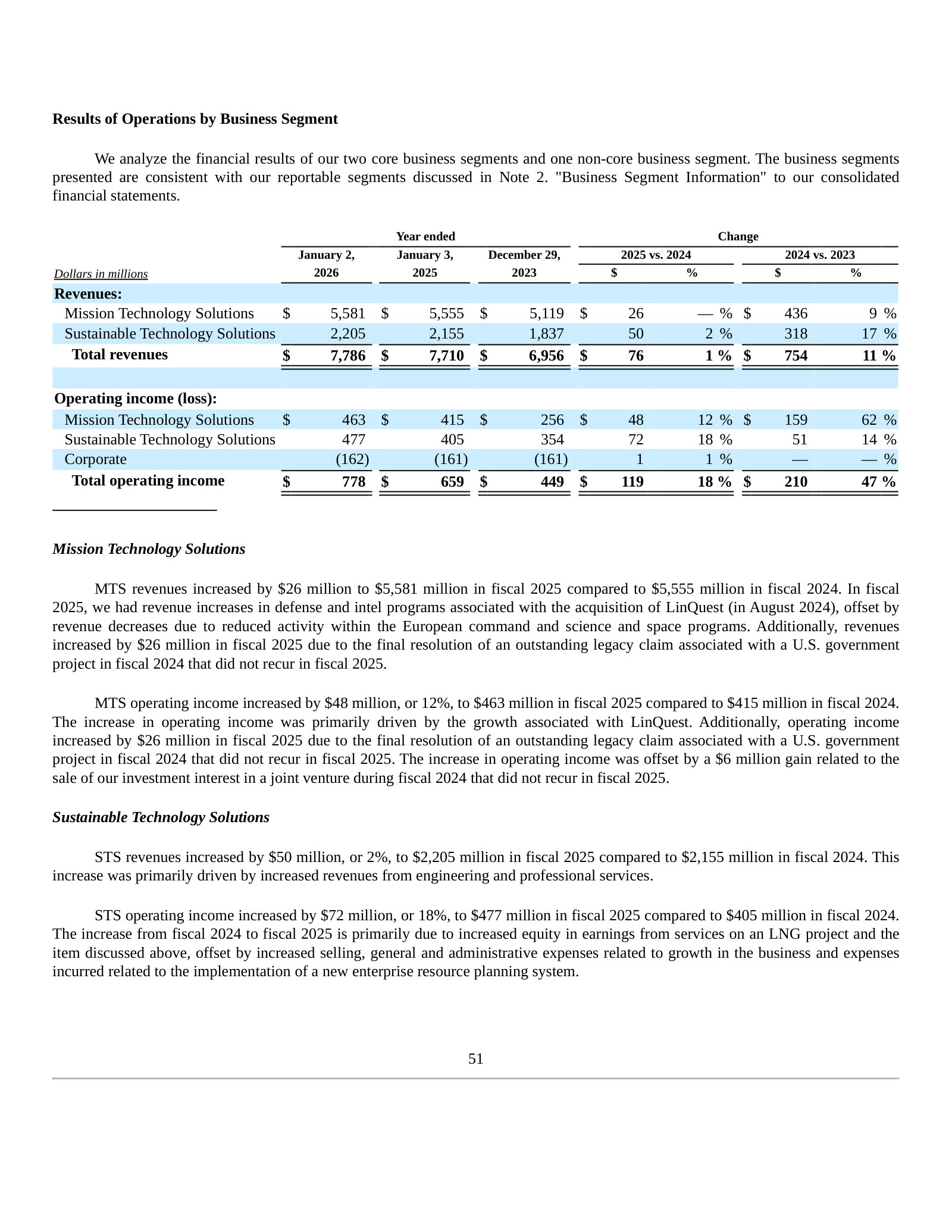
What actually moved MTS revenue — LinQuest offset by European command and space program declines.
MTS revenues increased by $26 million to $5,581 million in fiscal 2025 compared to $5,555 million in fiscal 2024. In fiscal 2025, we had revenue increases in defense and intel programs associated with the acquisition of LinQuest (in August 2024), offset by revenue decreases due to reduced activity within the European command and science and space programs.
p. 85 · Read in context →
Item 7. MD&A — Critical Accounting Policies and Estimates — p. 97 · Read the full section →
The policy that defines a contractor's earnings: over-time revenue on the cost-to-cost method, driven by cost-to-complete estimates.
KBR, Inc. — Fiscal 2024 Annual Report (Form 10-K) — Fiscal 2024 (year ended Jan 3, 2025)
Included to show the segment before the recast: the same defense/space business was reported as 'Government Solutions,' a year before the rename and planned spin-off. · Open the full document →
Item 1. Business — Our Business Segments — p. 14 · Read the full section →
The prior-year name for today's Mission Technology Solutions — evidence of the fiscal-2025 rebrand and reorganization.
The segment reported as 'Government Solutions' in fiscal 2024, later renamed Mission Technology Solutions.
Government Solutions. Our Government Solutions business segment provides full life-cycle support solutions to defense, intelligence, space, aviation and other programs and missions for military and other government agencies primarily in the U.S., U.K. and Australia.
p. 14 · Read in context →
More annual reports
KBR, Inc. — Fiscal 2023 Annual Report (Form 10-K) — Fiscal 2023 (year ended Dec 29, 2023) · 142 pages · Pre-LinQuest, pre-spin-off baseline: $6,956M revenue with the legacy legal settlement and convertible-note charges booked that year. · Open →
KBR, Inc. — Fiscal 2022 Annual Report (Form 10-K) — Fiscal 2022 (year ended Dec 31, 2022) · 160 pages · Earlier Government Solutions / Sustainable Technology Solutions structure for multi-year trend comparison. · Open →
KBR, Inc. — Fiscal 2021 Annual Report (Form 10-K) — Fiscal 2021 (year ended Dec 31, 2021) · 181 pages · The earliest edition on hand, useful for tracing the pivot from legacy E&C toward government and technology services. · Open →